You want one whole Bitcoin. The price keeps scaring you off.
Maybe you've thought about it for a while. One whole Bitcoin. Not a few dollars' worth. One coin, sitting in a wallet only you control.
Then you look at the chart. It jumps 20% in a month and drops 30% the next. You wait for a better price, and the price runs away. You buy after it runs, and it falls. Every time you look, it feels like you're about to make a mistake.
That feeling is the real problem. Not the price. The feeling that you have to get the timing right.
You don't. This article shows why, with the numbers.
You don't have to buy a whole coin
Here's the good news: you don't need $64,500 to start.
A dollar is split into 100 cents. A Bitcoin is split into 100,000,000 smaller pieces called sats, short for satoshis. You can buy as little as you like.
Most exchanges let you buy $10 worth of Bitcoin, and many let you buy $1. At today's price, $1 buys about 1,550 sats, and $10 buys about 15,500.
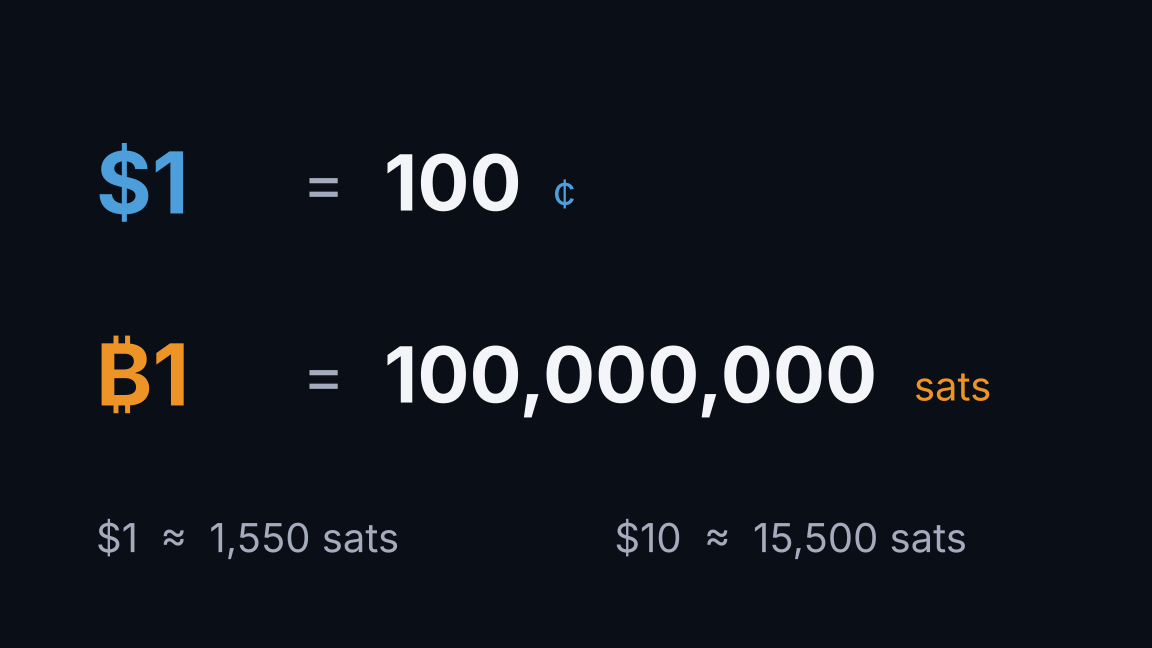
So one whole Bitcoin isn't one big purchase. It's 100 million sats, and you can collect them a few dollars at a time. Bitcoiners call that stacking sats.
Why even 0.1 Bitcoin is rare
Only 21 million Bitcoin will ever exist. No company, government or committee can print more. About 20.11 million have been mined so far. Some of those are gone for good because their owners lost the keys, but nobody knows how many. A coin that hasn't moved in years may be lost, or it may simply belong to someone very patient.
Now compare that with people. There are about 8.3 billion of us.
- If every coin were shared out evenly, each person would get about 0.0025 Bitcoin. That's about 253,000 sats, worth roughly $163 today.
- A whole Bitcoin is enough for only about 1 in every 395 people.
- Even 0.1 Bitcoin is enough for only 210 million people. That's about 1 in 40.
Picture 1,000 people in a room. If all 21 million coins were cut into 0.1 Bitcoin pieces, only 25 of those 1,000 people could have one.
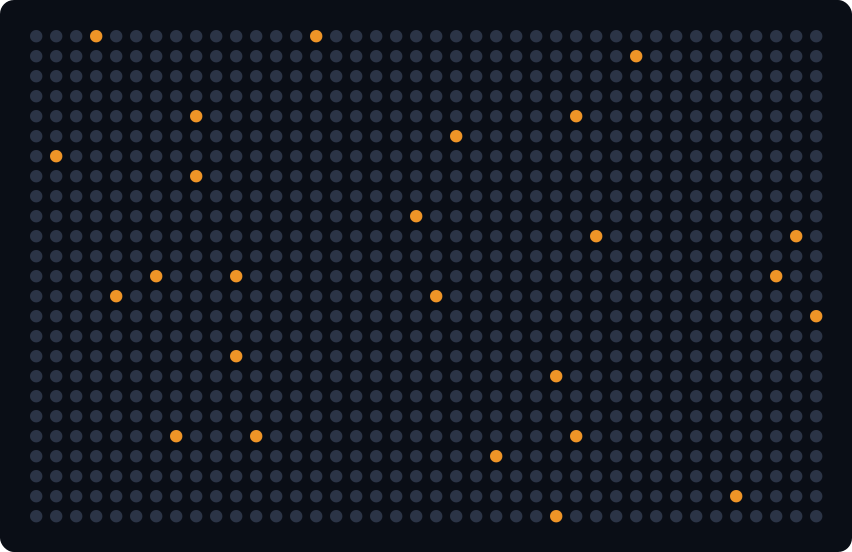
And that's the best case, because it counts every coin, including the ones not even mined yet and any that are lost.
So you don't need a whole coin to stand apart. Holding 0.1 Bitcoin already puts you in a group smaller than 3 in every 100 people. A whole coin makes you what Bitcoiners call a whole coiner.
The race for whole coins
Now look at the people with money to spend. There are about 57.5 million millionaires in the world, and nearly a million more join them every year.
Do the math:
- Imagine all 21 million coins handed out evenly to millionaires and nobody else. Each one would get about a third of a coin (0.37 Bitcoin). Not a whole one.
- If every millionaire wanted a whole coin, there would only be enough for 21 million of them. That's about 1 in every 3 millionaires.
- Each year the network creates about 164,000 new Bitcoin. In the same year, nearly a million new millionaires show up. That's about 6 new millionaires for every new coin.
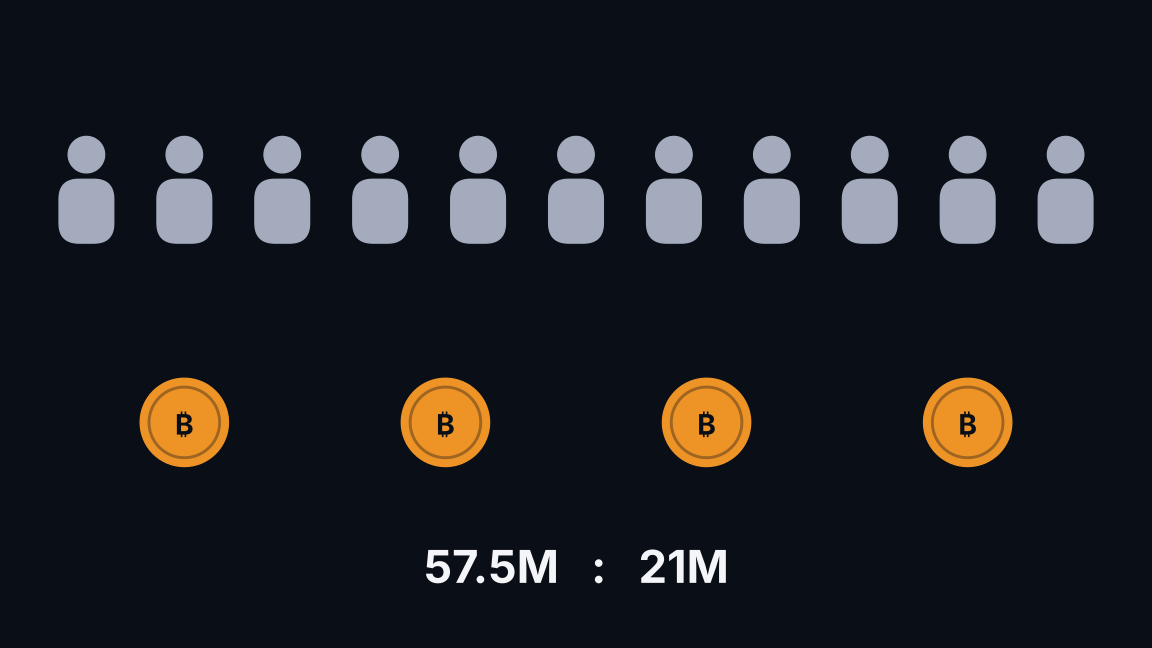
So if the world's millionaires ever decide they each want one whole Bitcoin, most of them can't have one. Not at any price.
Some Bitcoiners take this a step further, with an idea called Hyperbitcoinization. Daniel Krawisz coined the term in 2014. It became famous in 2023, when Balaji Srinivasan, a former Coinbase executive, publicly bet $1 million that Bitcoin would reach $1 million within 90 days. It didn't, and he closed the bet early.
The idea is the opposite of hyperinflation. In hyperinflation, people run away from a currency that keeps losing value. In Hyperbitcoinization, they run toward Bitcoin, and because its supply can't grow to meet them, the price climbs faster and faster. In countries with very high inflation, people already reach for whatever holds its value.
That's a theory, not a forecast. It may happen slowly, partly or not at all. Governments may push back, and Bitcoin can still fall hard along the way. But you don't need the theory to come true to see the point: the number of coins is fixed, and the number of people who want them keeps growing. Every sat you stack today is one that nobody else can buy.
Why the quick buck crowd gets hurt
Bitcoin has never gone up in a straight line. In each past bear market, it fell between 77% and 85% from its record high before it recovered. As of November 2026 it trades around $64,500, roughly 49% below its last record of about $126,000 in October 2025.
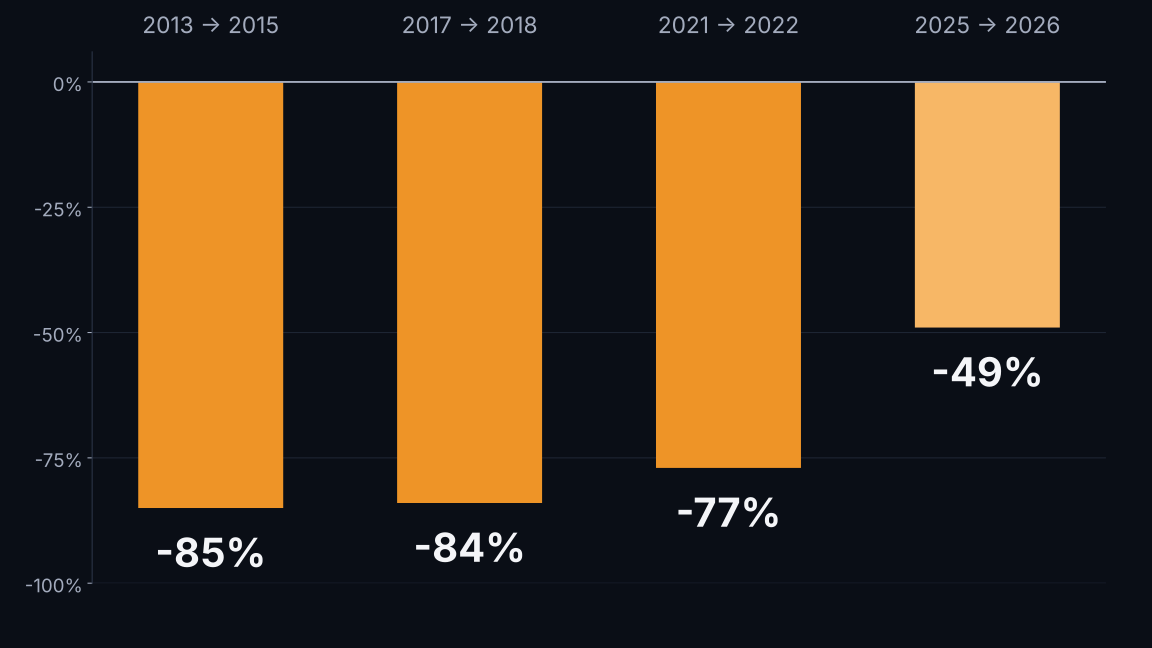
Picture putting in $10,000 and watching it become $2,000. Most people can't sit through that. They sell near the bottom, lock in the loss, and decide Bitcoin is a scam.
If your goal is a quick profit, that drop will find you. You'll buy in the excitement and sell in the fear. It happens to smart people every cycle.
The people who did well weren't braver. They just weren't in a hurry.
Meet Omar, the unluckiest Bitcoin buyer
Let me tell you about Omar. Omar is made up, but his prices are real.
Omar has the worst timing in the world. Every cycle he waits until Bitcoin is all over the news, then buys $1,000 at the exact top. Not near the top. The very top.
- 2013: buys $1,000 at about $1,150. He gets 0.87 Bitcoin.
- 2017: buys $1,000 at about $19,800. He gets 0.05 Bitcoin.
- 2021: buys $1,000 at about $69,000. He gets 0.0145 Bitcoin.
- 2025: buys $1,000 at about $126,000. He gets 0.0079 Bitcoin.
Each time, the price crashed right after he bought. Each time, he felt foolish. But he never sold.
Here's where Omar stands today, with Bitcoin around $64,500:
- He put in $4,000 in total.
- He owns about 0.94 Bitcoin.
- It's worth about $60,800.
- That's about 15 times his money, a gain of roughly 1,420%.
- His average price is about $4,240 per Bitcoin.
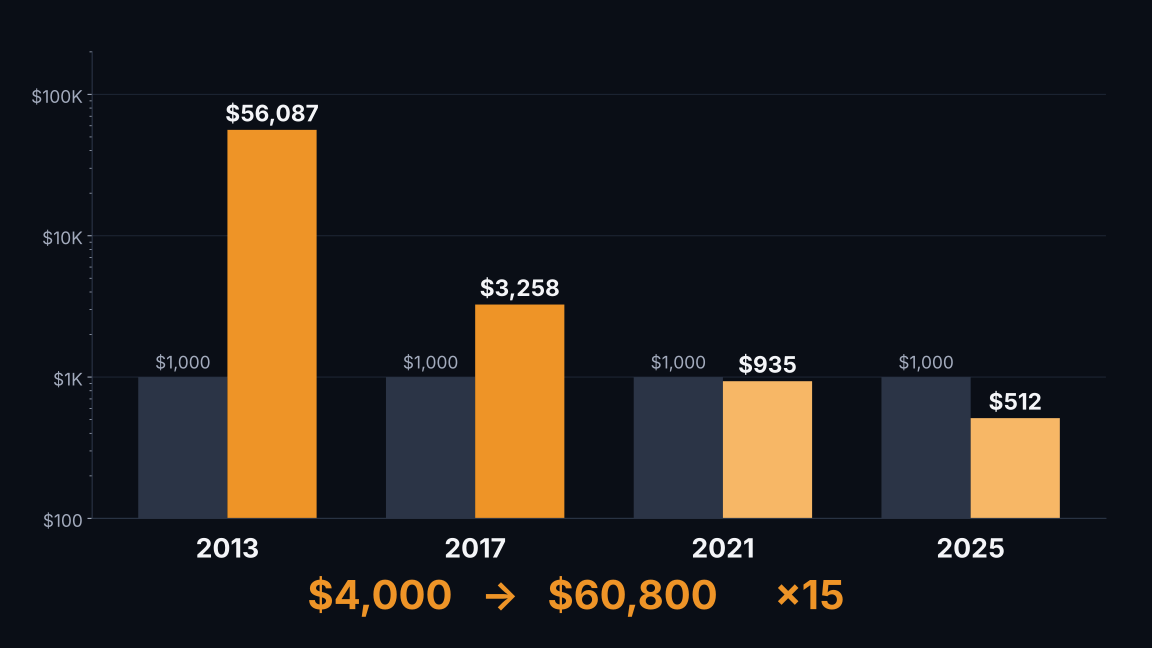
Two of his four buys are worth less than he paid right now. The 2021 buy is down about 7%, and the 2025 buy is down about 49%. Look only at those two and you'd call Omar a failure.
Look at the whole thing and he's almost a whole coiner, with $4,000 and the worst timing possible.
These prices are rounded and vary a little by exchange. I left out the 2011 top on purpose. Bitcoin was tiny then and hard to buy, and including it would make Omar look even better.
What zooming out means
Zooming out means stepping back from today's chart and looking at the whole history at once.
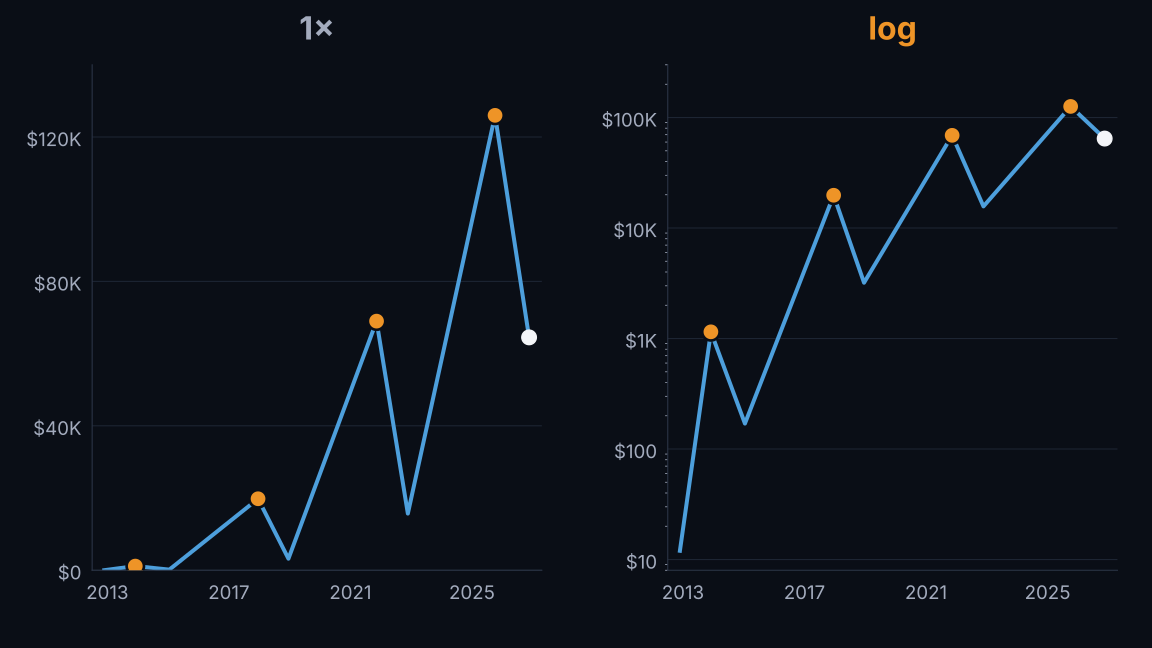
Up close, Omar's 2025 buy looks like a disaster. Zoom out to the last ten years and that same buy is a small dent on a line that climbs from the bottom left to the top right.
Here's an easy way to picture it. Stand with your nose against a mountain and every rock looks like a cliff. Walk a kilometre away and you see the shape of the whole mountain.
That's also why long-term Bitcoin charts are usually drawn on a log scale. On a normal chart, a move from $1,000 to $2,000 looks tiny next to a move from $60,000 to $70,000. On a log scale, every doubling takes up the same height, so $1,000 to $2,000 looks just as big as $60,000 to $120,000. That's what people mean by Bitcoin's logarithmic growth: it has grown by multiplying, not by adding.
Treat it like your retirement account, not a lottery ticket
Think about how people build a retirement account, like a 401k in the US. They put in a little from every paycheck. They don't check the price every morning. They don't sell when the news is scary. They let time do the work.
That habit has a name: dollar cost averaging, or DCA. You buy a fixed amount on a fixed schedule, whatever the price. When the price is high, your money buys a little. When it's low, the same money buys more. Over time you end up with a fair average price, and you never had to guess.
Omar's story is DCA at its worst: four buys, every one at the top. Real DCA buys on the good days and the bad days, so most people end up with a better average than Omar did.
Here's what makes Bitcoin different. In past cycles, it grew much faster than the stock market. If that continues, a steady retirement-style habit could get you to your goal sooner. That's an if, not a promise. Which is exactly why you only use money you can leave alone for years.
A simple plan to stack your first whole coin
- Pick an amount you won't need for at least four years. Money you might need next year will force you to sell at the wrong time.
- Buy on a schedule. Weekly or monthly, the same amount each time. Even $10 a week stacks up. Set it up and stop watching the chart.
- Move your coins to a wallet only you control. If you don't hold the keys, you don't fully own the coin.
- Zoom out once a year, not once a day. Check your average price and how many sats you hold. That's the only score that matters.
Want to see what your own money could buy?
My free plan has a simulation built in. Type in an amount and it shows how much Bitcoin you'd stack in each buy zone, and what it could be worth if the plan plays out. Run the plan with your money.
If you want to go further, I also share the exact plan I follow with my own portfolio. It's DCA with one twist: instead of buying on a calendar, it buys more when price comes back to the 200-week moving average, Bitcoin's long-term average. Read the 200-week moving average plan.
The bigger risk is not learning
For most of history, saving meant putting money in the bank and waiting. Today prices rise every year, and money sitting still buys a little less each time. Doing nothing isn't safe anymore. It just loses slowly.
Bitcoin may not be right for you. That's a fine conclusion to reach. But reach it by learning, not by avoiding the subject. The supply won't grow to wait for you, and every year of waiting can put a whole coin further out of reach.
So start small. Learn how it works. Buy a few sats on a schedule. Hold your own keys. Zoom out.
Omar did everything wrong except one thing: he kept going. You can do better than Omar.
Not financial advice. This article is for education. Past prices don't promise future results, and Bitcoin can lose a large part of its value. Only invest money you can afford to leave alone for years.